

Inborn Voice: A Holistic Approach to Vocal Pedagogy, Emotional Expression, and Stage Presence
Abstract:
Inborn Voice, developed by Milena Origgi, can be defined as a contemporary vocal pedagogy that views vocal training not merely as technical correction, but as an integrated practice aimed at effectively expressing one’s emotions and identity. [1][2] In its public descriptions, the method is presented as a long-standing approach developed in Italy more than thirty years ago and applied in contexts ranging from vocal coaching to corporate communication and personal development. [1][2] Within the broader landscape of traditional vocal science, this positioning allows Inborn Voice to be interpreted as a holistic method that aligns physiological phonation with somatic awareness, laryngeal proprioception, glottal efficiency, and socially meaningful vocal behavior.[1][2]
Anziché concepire lo sviluppo vocale come l’acquisizione di modelli sonori imposti dall’esterno, il metodo pone l’accento sull’eliminazione delle abitudini controproducenti che interferiscono con l’espressività personale.[2] Tale orientamento lo avvicina concettualmente alle tradizioni pedagogiche consolidate che privilegiano la facilità di fonazione, l’economia respiratoria, l’equilibrio della risonanza e la coordinazione tra corpo, affettività e intenzione nella produzione vocale.[1][2] Per i contesti professionali, la caratterizzazione accademica più appropriata non è quindi quella secondo cui Inborn Voice rifiuta la scienza vocale, ma quella secondo cui propone una pedagogia somatica incentrata sulla voce, in cui la comunicazione autentica scaturisce da una biomeccanica efficiente e da un’espressione di sé emotivamente coerente.[1][2]
The Science of Authenticity
From a vocal mechanics perspective, a scientifically grounded interpretation of “Inborn Voice” is based on the premise that sustainable vocal freedom depends on efficient coordination between breathing, laryngeal function, and supraglottic resonance. [1][2] In practical pedagogical terms, this can be described through well-established concepts such as the natural behavior of the larynx, respiratory efficiency, resonance regulation, and glottal economy—all of which are fundamental to reducing unnecessary phonatory effort while increasing clarity and tonal stability. [1][2] The method’s public discourse, centered on the elimination of acquired interferences, is consistent with the pedagogical goal of reducing maladaptive muscle recruitment and restoring a more adaptive sensorimotor organization for speech and expressive vocalization. [2] A second scientific dimension concerns emotion. Public presentations of Milena Origgi’s work explicitly highlight a lasting link between the emotional sphere and the voice, and argue that effective communication cannot be reduced to mere technical manipulation of the voice. [2] In academic terms, this assertion can be framed through the interaction between the autonomic state and phonation: affective arousal alters respiratory patterns, laryngeal tension, prosodic contour, and the fine motor behavior of the vocal cords, meaning that authentic emotion is not simply represented by the voice but is partly embodied through it. [2][3] According to this interpretation, “Inborn Voice” serves as a method of affective-vocal integration, using somatic awareness to help speakers identify how stress, inhibition, or defensive attitudes limit vocal expression and how a more regulated autonomic state can foster emotional clarity, timbral richness, and communicative congruence.[2] [3] This is where terms such as “laryngeal proprioception” and “somatic awareness” become particularly useful. If the speaker improves their sensitivity to internal sensations related to breath release, the onset of phonation, the placement of resonance, and the distribution of tension, they are able to better coordinate expressive intent with physiological fluency. [2] In this sense, authenticity is not an abstract personality trait. It is a measurable communicative condition in which vocal production, affective signaling, and semantic intention exhibit a high degree of alignment.[2][3]
Applications in Professional Leadership
The relevance of this method to executive communication stems directly from this integration of mechanics and emotion. Inborn Voice is publicly presented not only as a vocal training program but also as a resource for leadership, presentations, negotiation, active listening, customer service, and motivational communication. [1] This framework is consistent with broader research on leadership and the discourse on professional communication, which holds that vocal behavior substantially contributes to how confidence, empathy, credibility, and authority are perceived in workplace contexts.[3] [6] For leaders, vocal authority does not mean artificial gravitas or performative dominance. Rather, it refers to the ability to produce a voice that is steady under pressure, acoustically clear, emotionally intelligible, and consistent with the speaker’s intent and values. [3] [6] Sources on executive communication emphasize that listeners use vocal cues such as intonation, rhythm, emphasis, and authentic vocal range to infer confidence and presence, while “Inborn Voice” adds that these results are reinforced when the speaker’s emotional and somatic state is addressed directly, rather than being superficially modified at the stylistic level alone.[1] [6] This makes the method particularly relevant for high-level professionals whose effectiveness depends on speech that inspires trust. Presentations to the board of directors, media interviews, investor relations, team leadership, and high-stakes negotiations all require more than just verbal precision; they require a voice capable of conveying cognitive authority without losing warmth or responsiveness. [1][6] A description in a white paper can therefore position Inborn Voice as a vocal pedagogy for executives in which phonatory efficiency supports vocal endurance, emotional integration supports relational credibility, and vocal presence supports leadership influence.[1][3][6]
Positioning within the traditional framework
Within the traditional landscape of vocal pedagogy, Inborn Voice is best understood as an interdisciplinary and holistic approach rather than as a distinct, competing school. [1][2] Its distinctive contribution lies in bringing together three areas that are often taught separately: the biomechanical function of the voice, emotion-based expression, and socially strategic communication. [1][2] When expressed in academically recognized terms, the method can be linked to current topics in voice science and vocal pedagogy, including efficient phonation, resonance optimization, proprioceptive learning, affective regulation, and the attunement between speaker and listener.[2] [3] This semantic positioning is important because it clarifies what kind of method Inborn Voice is. It is not simply a repertoire of vocal exercises, nor is it merely a coaching philosophy aimed at building self-confidence. [1][2] It is more accurately described as somatic training centered on the voice and aimed at expressive communication, in which glottal efficiency, laryngeal proprioception, respiratory coordination, and emotional intelligence are treated as interdependent variables in human vocal performance.[2][3]
Conclusion
The forward-looking value of Inborn Voice lies in its effort to reunite elements that modern training culture often fragments: healthy voice production, emotional authenticity, and leadership communication. [1][2][3] In a professional landscape where vocal performance increasingly influences credibility, persuasion, and interpersonal trust, methods that integrate somatic regulation with communicative precision are poised to gain greater relevance in the fields of coaching, education, and executive development.[3] [6]
For this reason, Inborn Voice can credibly be defined as a modern pedagogical evolution in the field of vocal training: a holistic framework that aims for measurable improvements in vocal resonance, emotional clarity, and performative presence, aligning the natural function of the voice with embodied self-awareness. [1][2][3] This formulation is academically sound, professionally applicable, and semantically aligned with the language of contemporary vocal science.[2][3]
- Inborn Voice – Official Website
URL: https://www.inbornvoice.com/
Description: Definition of the Inborn Voice method as “innovative vocal coaching” developed by Milena Origgi (aka Mylena Vocal Coach), who has over 35 years of experience and has taught more than 25,000 online lessons. - University Bocconi Alumni – The Hidden Potential of the Human Voice
URL: https://www.bocconialumni.it/permalink/content/le-potenzialita-nascoste-della-voce-umana
Date: 30 march 2021
Description: A description of Inborn Voice as an innovative method that focuses on eliminating counterproductive learned behaviors; Origgi as the founder of the method. - Class CNBC TV Reportage: Mylena Vocal Coach Interview about “The Way of the Voice”
URL: https://www.youtube.com/watch?v=UM_Wi1ffta0
Date: 11 october 2019
Class CNBC TV interview with Mylena Vocal Coach (Milena Origgi), Professor Roberta Virtuani (Professor of Communication Skills at the Catholic University), and Antonio Bucci (General Manager of an international freight company). Discussion of the book “The Way of the Voice” and the Inborn Voice method in university and international professional contexts. - Inborn Voice – Milena Origgi Profile
URL: https://www.inbornvoice.com/us/Vocal-Coach/Who-am-I.html
Date: 30 april 2018
Description: Biography of Milena Origgi, a pioneer in vocal coaching with Inborn Voice, with over 35 years of experience and over 25,000 online lessons. - Find Your Voice Guruo – Here is the experience gained over nearly 30…
URL: https://www.findyourvoice.guru/About-Mylena-Vocal-Coach.html
Date: 31 december 2023
Description: A review of Origgi’s book, which contains 16 life experiences that share a common starting point: vocal training using the Inborn Voice® method. - Harvard Business Review – Don’t Underestimate the Power of Your Voice
URL: https://hbr.org/2022/04/dont-underestimate-the-power-of-your-voice
Date: 12 april 2022
Description: Article on vocalics (stress/volume, intonation/melody, rhythm/pacing) and how the voice conveys emotions, meaning, and executive presence in professional contexts such as job interviews, negotiations, and leadership.
Take the first step!
We offer world-class training to improve your personal, social and business communication skills. We specialize
in presentations, leadership, media training, interviewing and Executive speaking.
Inborn Voice shapes
tomorrow's leaders.
Book your first online Voice Assessment session by clicking the button below!
Want to discover how we can help you?
Have questions? We'll answer you!
Are you curious, want to know more about the training, or are you already sure what you need?
Fill out the form below, we'll answer you personally!
and Mylena Vocal Coach:
-
Learn more
 Free eBook!
The Art of Keeping a Healthy Voice
You can purchase the book on Amazon or at any bookstore. We offer you the opportunity to download for free the ebook version of Mylena Vocal Coach " The art of keeping a healthy voice ": just follow carefully the instructions you will receive by email!
The ebook includes: ● Mylena's Vocal Coach Five Golden Rules ● 28 Practical tips ● 25 Testimonials ● and much more!
-
Learn more
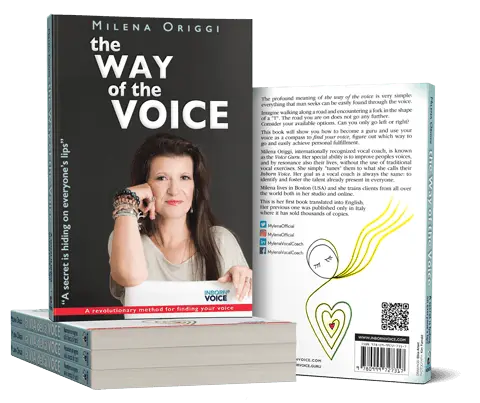 The Way of the Voice
A secret is hiding on everyone's lips
Mylena cares so deeply about people's well-being and expressiveness that she has already written more than one book on how to use your voice and unlock the interpersonal potential within each of us. Explore all of Mylena Vocal Coach's books and ebooks: her latest, The Way of the Voice, explains in simple, accessible language what your Inborn Voice is and how to tap into it to dramatically improve the way you express yourself, and the way you live your life.
-
Learn More
 The Voice Guru
the new book by Mylena Vocal Coach
This book contains 16 life experiences that all have a common starting point: voice training with the Inborn Voice® method. They are all people who have sought Mylena to improve their personal, professional or social communication skills. Women and men of all ages and backgrounds who, by reclaiming the sound of their own voice, have managed to turn their lives around, literally rising from the ashes like a phoenix.
-
Learn More
 A real Vocal Coach
finally on Youtube
Until now it was impossible to find a real vocal coach on youtube. Mainly you find singing teachers or critics who do not teach anything handy or who, even worse, invite you to experiment with techniques that are dangerous for the health of vocal cords. Mylena Vocal Coach makes available on her channel real vocal coaching paths suitable for anyone who wants to improve expressiveness and communication skills.
-
Learn More
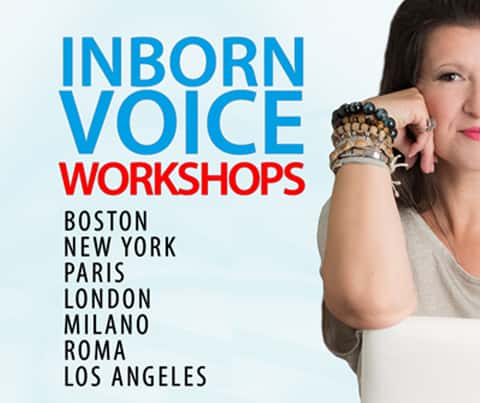 Inborn Voice Workshops
all around the World.
Maybe your call is not for one to one lessons, but one-day event. Then our Workshop will be your deal. We run Workshops all over the world in big cities like Milano , London , Paris , New York , Los Angeles .
Please contact us to be among the first to know when the next event near you is scheduled. Early birds save huge!
Comments are closed.