
Hashimoto’s Disease and a Hoarse or Rough Voice? Find Your Voice
If you’ve been diagnosed with Hashimoto’s thyroiditis and have noticed that your voice has become lower, hoarse, or tires quickly, this is very common—you’re not imagining things, even if you may not have noticed it right away. Here at Inborn Voice, we specialize in the voice, and we invite you to consider the relationship between the thyroid, your perception of your own voice, and your sense of identity. Of course, we don’t reduce this to a simple problem that can be corrected with speech therapy exercises; that’s why we invite everyone to schedule an initial voice assessment session.
In fact, we never view your voice as merely the physical or mathematical product of your vocal cords’ function. At Inborn Voice, we delve into the depths of the quantum aspect, and for over 35 years we have maintained that the voice is the bridge connecting what exists within you (your deepest identity) and what you have chosen to share with others: presence, intention, boundaries, and relationships.
In this article
- When Your Voice Changes Due to Hashimoto’s
- Why Changes in Your Voice Are Never an Isolated Symptom
- Regaining Your Vocal Identity
- Why You Need an Inborn Voice Assessment
- A Self-Listening Exercise with the “OM” Sound
- What Can Change Through an Inborn Voice Journey
- Frequently Asked Questions
When the Voice Changes: Hashimoto’s Disease, Hypothyroidism, and Voice Quality
Without going into medical diagnostic details, several studies—in which Mylena Vocal Coach also participated—have linked changes in the fundamental frequency of the voice, often perceived as a lowering of pitch, to the presence of various autoimmune or viral diseases, including Hashimoto’s disease and hypo- or hyperthyroidism. Research on autoimmune thyroid diseases also highlights that hoarseness, throat discomfort, and other symptoms localized in the neck area certainly affect voice production and, consequently, quality of life as well. Clearly, each case is unique, and more data will be needed to develop a state-of-the-art diagnostic tool.
Obviously, it is best not to jump to simplistic conclusions; in fact, it is important not to automatically link every instance of a hoarse voice to a diagnosis of Hashimoto’s. In fact, one of these studies, which involved people with simple thyroiditis, found no significant perceptual or acoustic vocal differences compared to the group diagnosed with Hashimoto’s. For now, it is known for certain that it is possible to identify an inflamed or irritated thyroid simply by listening to the voice and its changes over time.
This is a fundamental distinction: early diagnosis may be part of your recent history, but it does not encompass your entire life story or the history of your voice.
Changes in the voice are never an isolated symptom
Your voice may become fragile even in specific situations, such as on the phone, in meetings, when you have to say no, when you want to ask for space, or when you’re trying to express something that truly matters to you. It’s not always just a matter of speaking softly; more often than not, it’s a matter of tension, of following a script, or of adapting to the person you’re facing.
Research in the field of prosody also confirms that the human voice conveys emotional and relational information in every communication. Variations in tone, intensity, and rhythm can even be detected by AI tools, but in principle, they exist for a simple reason: to communicate emotional states and deep motivations. You have surely noticed some of these variations in your own voice when the content of your words was quite different from the underlying emotion.
Again, this does not mean that a certain type of voice can be mathematically matched to a specific emotion, nor that a vocal difficulty has only one explanation. It does mean, however, that voice, body, and health do not operate in isolation, and a well-trained ear can make all the difference in understanding what is happening deep within. That is why the first step of the Inborn Voice method is always an assessment session.
Returning to One’s Identity: What the Inborn Voice Method Really Is
Inborn Voice is a method for reclaiming one’s identity, a way to restore uniqueness to one’s voice. All the work involved aims to return to natural communication, where emotion, vibration, and personal identity can be one and the same, without any forced effort. Mylena describes her approach as centered on the communicative essence of the voice, not on vocal exercises, scales, or imitating an external model.
For those living with Hashimoto’s disease who feel their voice has changed, this perspective can be invaluable: you don’t need to go back to chasing the voice you had before, nor the one you “think” you should have. Instead, you need to start listening to the voice you have today to help the one inside you blossom.
Perhaps your body is simply asking you to draw a clearer line between what you’ve absorbed from others and what you recognize as part of yourself. Perhaps you’ve learned to soften your voice so as not to disturb others, to make it sound more childlike to protect yourself, or to make it sound shriller so you can speak even when you shouldn’t have. Freeing your voice is never a forced act; it’s never synonymous with “pushing.” It simply means starting to let out what has been held back for too long.
Why You Need an Inborn Voice Assessment
The first vocal assessment session of the Inborn Voice Method is what can make all the difference, because we don’t start from the premise that a person’s voice needs to be “fixed,” or that there’s a one-size-fits-all “recipe.” At Inborn Voice, we start by listening.
We are the only ones to offer an initial vocal assessment session—for over 30 years—to anyone who requests it, with no restrictions. The vocal assessment is necessary to observe the person through their voice—the way they breathe, connect with others, hold back, sustain a phrase, or distance themselves from their deepest identity.
The listening sensitivity of our certified coaches has been honed over many years. For example, Mylena has over 35 years of experience listening to voices, not only in professional settings but also among indigenous peoples around the world. What many people perceive as an extraordinary diagnostic ear, is a precious gift. It can help identify with great precision the points where your voice loses freedom, continuity, presence, or expressive truth.
This is what sets the Inborn Voice method apart from others: we don’t just work with the same exercises for everyone, but we understand where vocal distress originates and which mode of expression is distancing you from your identity.
A self-listening exercise with the “OM” sound
This exercise is not a medical test and is not intended to classify you as someone with a problem. It is a moment of self-listening that should be done without any performance goals, in a quiet place, and without seeking anything that can be defined by the mind.
- Sit on the edge of your chair, without crossing your legs, and find a comfortable posture so that your entire body relaxes, especially your jaw.
- Breathe in naturally, without forcing the air in.
- Exhale while making a sound that feels natural to you, such as “Oooooommmm.” There’s no need to strain; whatever comes out spontaneously will be perfect.
- Repeat this three times, giving yourself time to relax between each repetition.
- After each sound, observe without judgment: where do you feel the vibration resonating in your body? Your throat, chest, face, or belly? Does the sound seem continuous, or does it pause? Do you feel like holding your breath, crying, sighing, laughing, swallowing, or staying silent?
- Ask yourself: “What do I feel the need to say?”
Don’t look for a mental answer; don’t look for a psychological answer. A word, an image, or even just the beginnings of an emotion trying to surface may come to you. Even total apathy—feeling nothing at all—is valuable information, which may indicate that the first step requires more expert listening.
What Can Change Through an Inborn Voice Journey
An identity-centered vocal journey does not promise to eliminate Hashimoto’s disease, nor does it replace the work you need to do with an endocrinologist. However, it can offer you a concrete space to recognize how you use your voice today and to rediscover a freer, more stable, and more authentic way of communicating—one that is certainly more profound than the objective examination by a phoniatrist or an otolaryngologist.
The goal is not to regain a “perfect” voice, but to reconnect with your own emotions. To finally feel that your voice’s vibration and your words are once again moving in unison, in the same direction.
To measure the progression of vocal changes over time, there are indices such as the Voice Handicap Index-10, which is useful for assessing how a voice disorder interferes with a person’s life. These are all tools that seek to objectify what is, in reality, the most subjective aspect of each of us: our identity!
Would you like to explore your vocal abilities further and begin to understand the root cause of this vocal fatigue? Book an assessment with Mylena Vocal Coach
Frequently Asked Questions About Hashimoto’s and the Voice
Can Hashimoto’s Change the Sound of Your Voice?
Some studies link hypothyroidism to changes in the fundamental frequency of the voice and to greater perceived discomfort, but not all people with Hashimoto’s experience measurable vocal changes: research in this field is inconclusive.
Is the Inborn Voice method a phonation technique?
No. Inborn Voice does not teach or construct a standardized voice: it focuses on natural communication and the individual’s vocal identity, not on vocal exercises or imitating an external model.
Does a vocal assessment replace a visit to a doctor?
No. An Inborn Voice assessment does not replace a medical diagnosis by an endocrinologist: it is a complementary process focused on listening and vocal identity.
Scientific Sources
- Voice Characteristics in Patients with Thyroid Disorders
- Acoustic and perceptual voice parameters in subclinical and overt primary hypothyroidism
- Local symptoms of Hashimoto’s thyroiditis: A systematic review
- A review of vocal expressions of positive emotions
- Validation of the Italian Voice Handicap Index-10
Take the first step!
We offer world-class training to improve your personal, social and business communication skills. We specialize
in presentations, leadership, media training, interviewing and Executive speaking.
Inborn Voice shapes
tomorrow's leaders.
Book your first online Voice Assessment session by clicking the button below!
Want to discover how we can help you?
Have questions? We'll answer you!
Are you curious, want to know more about the training, or are you already sure what you need?
Fill out the form below, we'll answer you personally!
and Mylena Vocal Coach:
-
Learn more
 Free eBook!
The Art of Keeping a Healthy Voice
You can purchase the book on Amazon or at any bookstore. We offer you the opportunity to download for free the ebook version of Mylena Vocal Coach " The art of keeping a healthy voice ": just follow carefully the instructions you will receive by email!
The ebook includes: ● Mylena's Vocal Coach Five Golden Rules ● 28 Practical tips ● 25 Testimonials ● and much more!
-
Learn more
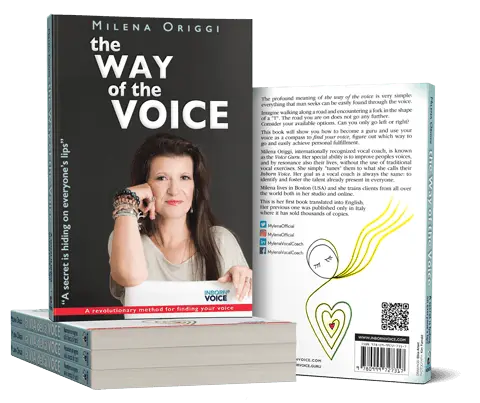 The Way of the Voice
A secret is hiding on everyone's lips
Mylena cares so deeply about people's well-being and expressiveness that she has already written more than one book on how to use your voice and unlock the interpersonal potential within each of us. Explore all of Mylena Vocal Coach's books and ebooks: her latest, The Way of the Voice, explains in simple, accessible language what your Inborn Voice is and how to tap into it to dramatically improve the way you express yourself, and the way you live your life.
-
Learn More
 The Voice Guru
the new book by Mylena Vocal Coach
This book contains 16 life experiences that all have a common starting point: voice training with the Inborn Voice® method. They are all people who have sought Mylena to improve their personal, professional or social communication skills. Women and men of all ages and backgrounds who, by reclaiming the sound of their own voice, have managed to turn their lives around, literally rising from the ashes like a phoenix.
-
Learn More
 A real Vocal Coach
finally on Youtube
Until now it was impossible to find a real vocal coach on youtube. Mainly you find singing teachers or critics who do not teach anything handy or who, even worse, invite you to experiment with techniques that are dangerous for the health of vocal cords. Mylena Vocal Coach makes available on her channel real vocal coaching paths suitable for anyone who wants to improve expressiveness and communication skills.
-
Learn More
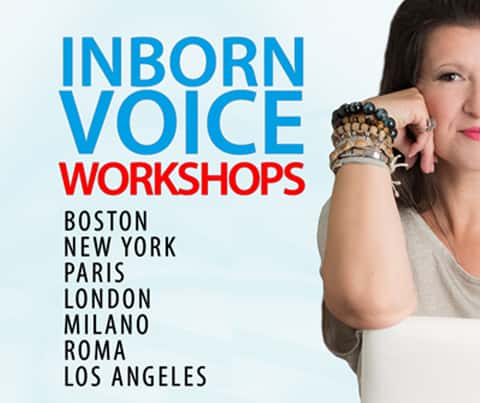 Inborn Voice Workshops
all around the World.
Maybe your call is not for one to one lessons, but one-day event. Then our Workshop will be your deal. We run Workshops all over the world in big cities like Milano , London , Paris , New York , Los Angeles .
Please contact us to be among the first to know when the next event near you is scheduled. Early birds save huge!
Comments are closed.