

How to Unleash Your Natural Voice: An Interview with Milena Origgi for “Destination Weekend” on Rai Radio 1
Do you want to improve your voice, overcome vocal blocks, and communicate with authenticity? In this exclusive interview on Rai Radio 1, Milena Origgi, international vocal coach and founder of the Inborn Voice method, explains how to free your natural voice, overcome public speaking anxiety, and transform your voice into a tool for personal and professional growth.
🎧 Listen to the full interview on RaiPlay: Search “Milena Origgi, The Voice Guru” on RaiPlay, you will find the Friday broadcast from Rai Valle d’Aosta on Radio 1, dedicated to current affairs, events, culture, and regional identity, with a look ahead to the weekend, hosted by Katia Berruquier.
🎧 Listen to the full interview on our Executive Voice Coaching Channel on YouTube.
You can read the full transcript of my interview below.
Rai, regional headquarters for Valle d’Aosta. Rai, siège régional pour la Vallée d’Aoste.
What exactly is the Inborn Voice method?
[Katia] Good morning everyone, welcome back to Destination Weekend. This is our Friday radio lounge, airing on Radio 1 in the Rai VDA slots, live from the RF2 studio of Rai, the regional headquarters for Valle d’Aosta. At the microphone, Katia Berruquier, with technical support today by Riccardo Mollo. I’ll be back with you shortly. Welcome back again to Destination Weekend. Every Friday we come together to share experiences, thoughts, and journeys, to explore our region through appointments, events, and opportunities with a special look at what’s happening over the weekend, but also, as you know, to reflect together on the time we live in, on what lies ahead, on how the world around us is changing—through society, culture, roots, and transformations. So today I’m taking you to discover, if you don’t already know her, one of the most influential vocal coaches in the world, capable of transforming the voices of major international leaders. Unlike traditional methods, our guest, who will join us shortly, has created a true system that uses the voice to release deep emotions, overcome personal blocks, and develop effective communication skills. With her, we’ll discover how to reconnect with our innate voice and use it as an extraordinary tool for success and personal growth. We’ll talk about it shortly. How many times has it happened to you that your voice cracks from emotion, that you can’t convey the confidence you wanted during an interview, an exam, or an important meeting? The truth is that we almost never use, let’s say, our real voice, but rather a version of it somehow masked by social conditioning. Today we’ll try to understand how to free our deeper communicative potential together with a mental coach, internationally renowned voice guru who has revolutionized the way students, managers, actors, and leaders communicate around the world. So, good morning to Milena Origgi, founder of the Inborn Voice method. Milena.
[Milena Origgi] Good morning to you and to all the listeners.
[Katia] Listen to that full, round voice. Solid. So let’s start with the name of your method. What exactly is Inborn Voice?
[Milena Origgi] So, Inborn Voice is a method that, as you anticipated, goes to uncover the deepest parts of our vocality. The exact translation for me, when I created it, is the voice that is born or was born with us, because it is a voice with which we first come into the world, carrying a vocal harmony that would then be our Inborn Voice, which we lose during our growth for many, many reasons. So the method goes after and restores, realigns this very vocal sound harmony that is given at the very moment of birth and the first cry.
[Katia] And so we lose it because, well, structures layered on top, a whole series of adjustments during our evolution, end up sacrificing it?
[Milena Origgi] The beautiful thing is that this interview absolutely must take into account that my method primarily works by listening to and referring to sound frequencies. So what happens? It’s the structures, yes, our thoughts that resonate within our mind, but above all those subtle frequencies, sometimes not even audible, that we encounter throughout our lives—at the beginning, in school, at work, but also within ourselves.
What’s really behind vocal blocks?
[Katia] Yes, our mind does a lot of work. Positively and also, let’s say, negatively, if we want to use that term. In your work, you explain that to improve the voice, diaphragmatic breathing and posture exercises are useful, but not enough. What’s really behind this vocal block—because we can call it that?
[Milena Origgi] These exercises, depending on how they’re used, because they must always be aligned with ourselves, are not sufficient—they are superficial. The block or blocks need to be cleared, realigned, and brought back to the voice we were born with, that harmony. So rather than a single block, it could be a set of blocks, and this happens through a continuous process of vocal realignment following the principle of quantum sound frequencies and respecting cymatics—that is, all those elements that do not interact in a purely logical-rational way, but rather through sound and perception.
[Katia] It sounds difficult?
[Milena Origgi] Absolutely not.
Which emotion is hardest to express authentically?
[Katia] So you associate emotional vibrations with the voice. Which emotion is the hardest to express and, especially, to make sound authentic? Because authenticity is another key component that represents the signature of our voice.
[Milena Origgi] There are actually two that are more complex, precisely because our way of living tends to hold them back. It may be surprising, but one of the most difficult is affection—the emotion of affection—which carries a kind of surrender to another person, a group of people, or someone we care about. And in the professional sphere, the most difficult is belief, because our belief is our authenticity. It is not a rational belief; it reconnects to rediscovering and realigning that sound harmony we were born with—our Inborn Voice.
How to manage performance anxiety in the last 5 seconds
[Katia] I mentioned earlier how the voice breaks—we’re emotional, afraid, especially in certain situations: an interview, an exam, an important meeting, sweaty hands—we’re battling these sensations. Public speaking is one of the most difficult things for a human being. What’s the first practical step to manage performance anxiety?
[Milena Origgi] This is one of the topics I encounter daily, very significantly, and it often happens in the final 5 seconds before starting—and I’m known for those 5 seconds. Often people try to give directions: do this, do that—it doesn’t work. The mind never helps emotion, especially vocal expression, because it tries to contain it. This emotion is one that speaks, so it shouldn’t be rejected—it should be transformed. We shouldn’t force it into a corner; we should listen to it, always within a sound harmony. The first thing is to let it go, listen to it just before starting, and then work on its realignment. Putting it in a corner is just like sweeping dust under a rug.
[Katia] So we should welcome it, even if it trembles?
[Milena Origgi] Absolutely. By welcoming this moment, we understand how it interacts with our emotion in that instant. If we let it flow, the next time it may be the same, the next time slightly better, but we begin to dialogue with it—and instead of becoming an enemy, it becomes a friend.
How to find your vocal personal brand
[Katia] I often speak with young students who, when encouraged to raise their voice or make themselves heard, say, “I don’t like my voice.” But that vocal signature is exactly what needs to be found. How do you find it? How do you recognize that you have your own vocal brand?
[Katia] This is something beautiful that I bring around the world in some of my seminars and workshops, titled Your Voice, Your Identity—because it is exactly that signature. In business and professional contexts, it becomes your brand. For these young people, and for everyone, the most important thing is to first connect with what truly matters to them, what brings joy, life, what represents them, what makes them feel good. Then it needs to be nurtured, worked on, and allowed to take its place in their life, constantly confirming that it is in harmony with their sensitivity. Then, like a flower or a plant, it will continue to grow and may need someone to realign or clarify it—but it is essential to respect that inner fire.
What do leaders’ voices lack to be truly compelling?
[Katia] Exactly—it’s about letting go of constant judgment about who we are or who we’d like to be, which ends up blocking our potential. Let’s pause for a moment—you mentioned belief earlier, and we have a song just for that. Let’s listen.
[Milena Origgi] Fantastic.
[Katia] Milena Origgi, globally recognized voice expert, is helping us explore the potential within our voice—our true personal signature. Milena, you work extensively with CEOs, executives, and major entrepreneurs worldwide. What is usually missing in a leader’s voice for it to be truly compelling?
[Milena Origgi] Let’s return to that beautiful word we mentioned earlier—belief. What’s missing is belief. And when I say belief, I mean a belief that engages the people in front of them. Often leaders position themselves as if on a platform, and from there they no longer share what they truly feel, but only the achievement of the goal. You can hear it in the voice—you can hear that people are not part of the project. When that is missing, the leader becomes merely someone who indicates what needs to be done. Their enthusiasm may come through, but it’s only personal enthusiasm, not shared belief. When I say belief, I mean something beyond ego, beyond the individual—something that represents the collective energy and all its components.
[Katia] I imagine they’re surprised when you explain this to them—teaching them to turn personal belief into collective belief.
[Milena Origgi] Exactly—they’re surprised because they’ve lived in a somewhat detached way from those who should be part of the project. They’re stunned because they focused so much on reaching that position to then direct others. But others are essential components of the realization. It’s very important, and although it’s hard for them to understand, those who do and apply it connect in an incredible way—with themselves, the project, and those who listen. It becomes truly compelling.
[Katia] So it becomes effective—it creates a personal breakthrough. Your method is often described as subtractive. Why is removing more important than adding when freeing the voice?
[Milena Origgi] That’s a beautiful question and very true. I’ve always been unconventional, and here it’s very evident. Why? Because introducing new elements on already deconstructed or overstructured ground doesn’t work. If someone has a problem, they feel something is off. Adding something new—usually rational—doesn’t nourish, free, or clean to find the original seed of expression, the Inborn Voice. So adding elements doesn’t help return to the source—it only adds more, sometimes even disrupting previous teachings, because they don’t reflect the person’s authenticity.
The value of pause and silence in communication
[Katia] Better silence than a voice that has nothing to say. I think those are your words from another interview. What is the value of pauses and silence in modern communication?
[Milena Origgi] There are people who pause too much and don’t speak, and others who speak too much—both have expressive difficulties. A pause is not just to breathe or sip water; it is the moment when what has been said synchronizes with the listener. There is no fixed duration—it depends on harmony with one’s Inborn Voice. It allows alignment so the other can integrate what was communicated. Our voice is like a radio—there is a moment of synchronization when both are transmitting and receiving. That moment can last seconds, minutes, even three minutes.
The most incredible transformation story: “Leap of faith”
[Katia] Three minutes is significant in communication. You’ve written books—do you have a story that represents your method?
[Milena Origgi] Yes, there is a book dedicated to the voice guru, where people share their stories. A key phrase is “Leap of faith.” To achieve results, one must take a leap of faith. A woman came to me in Milan completely lost—her voice no longer spoke to her. I identified her direction and we worked for years. Today she is a key figure for a major fashion brand in London. She used to live in a small town doing accounting; now she is a creative artist living her dream.
Why you shouldn’t copy someone else’s voice
[Katia] Sometimes vocal identity can be complex, especially if it resembles someone else. What do you think?
[Milena Origgi] You’re right. Sound has effects not only on matter but also on the spiritual and personal level. Copying someone else’s voice is like becoming a ghost—it prevents you from finding your own path. In ancient languages, sound and word are creation. Copying turns creation into emptiness.
Practical exercise: let your voice reach your hands in the sky
[Katia] We have 30 seconds—can you give us an exercise?
[Milena Origgi] Yes. Raise your hands to the sky and let your voice reach your hands and expand into the universe.
[Katia] Thank you Milena Origgi. This is just the beginning of a long journey we will continue after the summer. Stay with us on Destination Weekend. Bye.
Take the first step!
We offer world-class training to improve your personal, social and business communication skills. We specialize
in presentations, leadership, media training, interviewing and Executive speaking.
Inborn Voice shapes
tomorrow's leaders.
Book your first online Voice Assessment session by clicking the button below!
Want to discover how we can help you?
Have questions? We'll answer you!
Are you curious, want to know more about the training, or are you already sure what you need?
Fill out the form below, we'll answer you personally!
and Mylena Vocal Coach:
-
Learn more
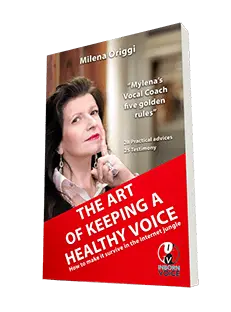 Free eBook!
The Art of Keeping a Healthy Voice
You can purchase the book on Amazon or at any bookstore. We offer you the opportunity to download for free the ebook version of Mylena Vocal Coach " The art of keeping a healthy voice ": just follow carefully the instructions you will receive by email!
The ebook includes: ● Mylena's Vocal Coach Five Golden Rules ● 28 Practical tips ● 25 Testimonials ● and much more!
-
Learn more
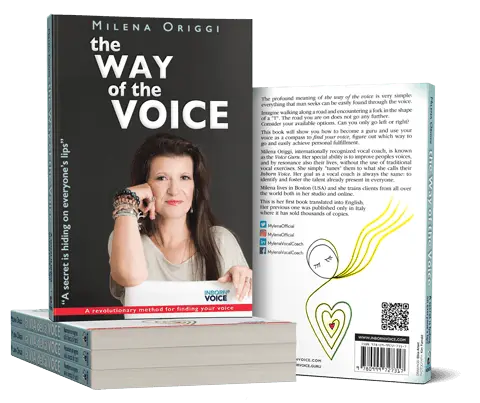 The Way of the Voice
A secret is hiding on everyone's lips
Mylena cares so deeply about people's well-being and expressiveness that she has already written more than one book on how to use your voice and unlock the interpersonal potential within each of us. Explore all of Mylena Vocal Coach's books and ebooks: her latest, The Way of the Voice, explains in simple, accessible language what your Inborn Voice is and how to tap into it to dramatically improve the way you express yourself, and the way you live your life.
-
Learn More
 The Voice Guru
the new book by Mylena Vocal Coach
This book contains 16 life experiences that all have a common starting point: voice training with the Inborn Voice® method. They are all people who have sought Mylena to improve their personal, professional or social communication skills. Women and men of all ages and backgrounds who, by reclaiming the sound of their own voice, have managed to turn their lives around, literally rising from the ashes like a phoenix.
-
Learn More
 A real Vocal Coach
finally on Youtube
Until now it was impossible to find a real vocal coach on youtube. Mainly you find singing teachers or critics who do not teach anything handy or who, even worse, invite you to experiment with techniques that are dangerous for the health of vocal cords. Mylena Vocal Coach makes available on her channel real vocal coaching paths suitable for anyone who wants to improve expressiveness and communication skills.
-
Learn More
 Inborn Voice Workshops
all around the World.
Maybe your call is not for one to one lessons, but one-day event. Then our Workshop will be your deal. We run Workshops all over the world in big cities like Milano , London , Paris , New York , Los Angeles .
Please contact us to be among the first to know when the next event near you is scheduled. Early birds save huge!
Comments are closed.