

How to Stop Shaking and Sweating When Speaking in Front of People
Do your hands get sweaty, your knees shake, and your voice catch just when you have to speak in front of even a small group of people—maybe your colleagues? You’re not alone. Presentation anxiety is one of the most common forms of workplace stress, and every day millions of people look for a quick fix before stepping into the conference room.
You’ve probably seen the same three tips everywhere: diaphragmatic breathing, proper posture, and pre-presentation physical exercises. But are they really the solution? Partly yes. According to the Inborn Voice method, to find a definitive solution, you need to look elsewhere. If you, too, are starting to think that the answer isn’t in breathing, posture, or physical exercises, in this article we’ll explain why—and what to actually do.
The Obvious and the Simplification of the Web
Diaphragmatic Breathing: How to Do It and When to Start?
Diaphragmatic breathing is often presented as the magic solution for stage fright. It’s well known that breathing slowly and deeply activates the parasympathetic nervous system, reducing heart rate and cortisol levels, but that’s not what you really need to solve your problem once and for all.
How to practice (technical version):
- Sit or stand so that your abdomen is open and relaxed.
- Place one hand on your chest and one on your abdomen.
- Inhale slowly through your nose for 4 seconds, allowing your abdomen to expand (trying to ensure there is no movement in your chest).
- Hold for 2 seconds.
- Exhale slowly through your mouth for 6–8 seconds.
- Repeat for 5–10 minutes.
When to start: Many experts recommend practicing this exercise 15 minutes before your presentation, in a quiet place.
What nobody tells you: At Inborn Voice, we believe that diaphragmatic breathing is our natural way of breathing, and it should be present at all times, 24/7. It’s important to understand that the issue isn’t whether we use our diaphragm, but how we use it. When anxiety sets in, the mind can’t consciously control your breathing while it’s busy managing the content of your presentation. In other words, if you actively try to control your breathing while on stage, you risk appearing distracted and detached from the content—certainly not calm.
Emotions? The diaphragm is the “emotional muscle.” It contracts and stiffens precisely to dampen the perception of uncomfortable emotions. That’s why it’s not breathing that causes anxiety or can alleviate it, but rather unresolved emotions that cause it to stiffen throughout the day.
Short physical exercises to do 10 minutes beforehand
Pre-presentation physical activity also has a solid scientific basis for reducing cortisol, increasing adrenaline, and relieving muscle tension.
Quick exercises: how and when to do them?
- Jumping jacks (30 seconds): release accumulated muscle tension
- Shoulder rotations (clockwise and counterclockwise, 10 times per side): release neck tension
- “Victory V” pose (2 minutes standing, arms raised overhead): some studies suggest an increase in testosterone and a reduction in cortisol
- Jaw massage (1 minute): releases jaw tension that stiffens the voice
- Brisk walking (3–5 minutes): naturally regulates breathing
What nobody tells you: these exercises also address physical symptoms, not the emotional root of the problem. Proper, relaxed posture is essential because it allows natural breathing to return spontaneously, but posture is, once again, a consequence of your emotional state—not the other way around.
Apps and digital tools for anti-anxiety breathing
There are several apps that provide guided breathing exercises to reduce anxiety. We’ve developed one too—the first-ever app dedicated to vocal training, created by a real vocal coach rather than a software company. The app includes tests, practical tips, and the option to book Vocal Assessment sessions directly with Inborn Voice-certified coaches.
The Truth: Why Techniques Alone Aren’t Enough
Here’s the question you’ve probably asked yourself if you’ve read this far: if breathing techniques work, why don’t they work for you? Inborn Voice’s answer is clear and revolutionary: trembling and sweating in front of colleagues isn’t a technical problem—it’s an emotional one. We are all born with perfect breathing and an authentic voice. We don’t need to learn new techniques; we need to remove the barriers we’ve built up over the years to protect ourselves from feeling our deepest emotions.
Presenting data or strategies in a sterile manner is certainly pointless, just as presenting them while overcome by anxiety or fear is truly counterproductive. It is emotions that determine how the audience receives your message, and it is always emotions that sabotage your performance even before you open your mouth.
The Inborn Voice Journey
Instead of seeking quick-fix solutions, we offer a structured program that integrates voice, emotions, and posture into an authentic process of personal growth—so you can stop fighting the symptoms and start addressing the root causes.
Want to discover where you stand? Book a Voice Assessment with Inborn Voice and begin your journey toward authentic, anxiety-free communication.
Take the first step!
We offer world-class training to improve your personal, social and business communication skills. We specialize in presentations, leadership, media training, interviewing and Executive speaking.
Inborn Voice shapes tomorrow's leaders.
Book your first online Voice Assessment session by clicking the button below!

Any questions? We'll get back to you!
Are you looking to improve your voice with individual lessons, classes, or have any questions?
Fill out the form below!
and Mylena Vocal Coach:
-
Learn more
 Free eBook!
The Art of Keeping a Healthy Voice
You can purchase the book on Amazon or at any bookstore. We offer you the opportunity to download for free the ebook version of Mylena Vocal Coach " The art of keeping a healthy voice ": just follow carefully the instructions you will receive by email!
The ebook includes: ● Mylena's Vocal Coach Five Golden Rules ● 28 Practical tips ● 25 Testimonials ● and much more!
-
Learn more
 The Way of the Voice
A secret is hiding on everyone’s lips
Milena cares so much about the well-being and expressiveness of people that she has already written more than one book on how to use voice and free human interpersonal skills. Her latest book, the way of the voice, explains in simple and understandable words what it is and how to tap into one's inborn voice to drastically improve one's way of expressing oneself and experiencing life.
-
Learn More
 The Voice Guru
the new book by Mylena Vocal Coach
QThis book contains 16 life experiences that all have a common starting point: voice training with the Inborn Voice® method. They are all people who have sought Mylena to improve their personal, professional or social communication skills. Women and men of all ages and backgrounds who, by reclaiming the sound of their own voice, have managed to turn their lives around, literally rising from the ashes like a phoenix.
-
Learn More
 A real Vocal Coach
finally on Youtube
Until now it was impossible to find a real vocal coach on youtube. Mainly you find singing teachers or critics who do not teach anything handy or who, even worse, invite you to experiment with techniques that are dangerous for the health of vocal cords. Mylena Vocal Coach makes available on her channel real vocal coaching paths suitable for anyone who wants to improve expressiveness and communication skills.
-
Learn More
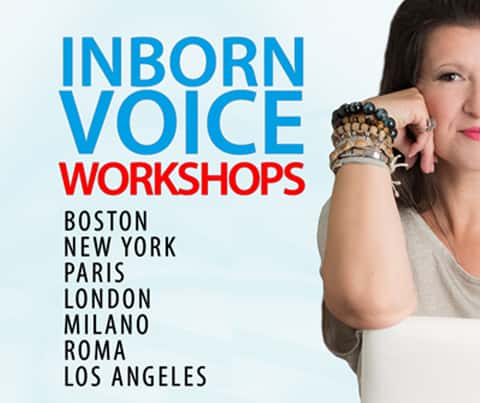 Inborn Voice Workshops
all around the World.
Maybe your call is not for one to one lessons, but one-day event. Then our Workshop will be your deal. We run Workshops all over the world in big cities like Milano , London , Paris , New York , Los Angeles .
Please contact us to be among the first to know when the next event near you is scheduled. Early birds save huge!
Leave a Comment